Stop Pathologizing Boys’ Need for Connection: Why Fear-Based Narratives About Masculinity Mislead Parents of Boys With ADHD
ADHD Dude is not a platform specifically for parents of boys. Roughly half of the families in our membership are parents of girls, and more than half of the parent-coaching appointments I conduct with membership families are with parents of girls.
I am addressing this topic because I have spent most of my career working with boys and their families. I worked as a school social worker in special education schools where most of the students were boys. In private practice, I provide groups for boys with ADHD to help them connect with other boys and sustain friendships. I am also the father of a son with ADHD who struggled socially.
I appreciate ADDitude and the opportunities they have provided me. I will always be grateful for them. That is also why I feel obligated to address this article in good conscience.
Over the years, I have encountered anti-male bias in the mental health field and in online neurodiverse communities. It often shows up in language that treats normal male development as something to correct rather than understand.
ADDitude's article, "How to Help Boys Escape from the Manosphere", reflects that same bias. It is not practical guidance about ADHD. It is cultural commentary that pathologizes boys' need for connection with other boys and men.
A Fear-Based Story About Boys
The article begins with this statement:
“The toxic masculinity pipeline is active online.”
It then explains that boys may enter this so-called pipeline while looking for advice about fitness, social skills, mental health, discipline, dating, or self-improvement.
Think about that list.
These are not unusual or alarming interests. They are common concerns for adolescent boys, especially boys who do not feel socially successful.
A boy may want to become stronger because he feels physically insecure. He may search for information about self-discipline because he struggles with eating healthy. He may want help becoming more confident because he wants connection with his male peers but feels awkward around them.
The article places these normal concerns at the entrance to a dangerous pipeline.
When articles like this focus almost entirely on the worst examples, they create a fear-based narrative. Parents are left with the impression that male-oriented spaces are dangerous, that boys are easily manipulated, and that seeking connection with other boys and men is itself a warning sign.
It takes the most extreme online content and uses it to define a much broader range of normal male interests and relationships. Extreme content gets disproportionate attention because fear and outrage generate engagement.
Boys Have Critical-Thinking Skills
The article treats male-oriented online spaces like dangerous black holes. A boy goes looking for fitness advice, confidence, discipline, dating help, or social skills, and the assumption is that he may be pulled into misogyny before he understands what is happening.
Boys have critical-thinking skills. A boy can listen to advice from another male without accepting every opinion that person holds. Parents can help boys evaluate online content without teaching them that male-oriented content is inherently toxic.
Many boys are simply looking for connection with other boys and men. They want guidance from people who understand their experiences. They want to feel more confident, capable, and respected.
Treating those needs as risk factors does not help parents understand their sons. It pathologizes normal male development.
Boys Often Connect Through Shared Interests
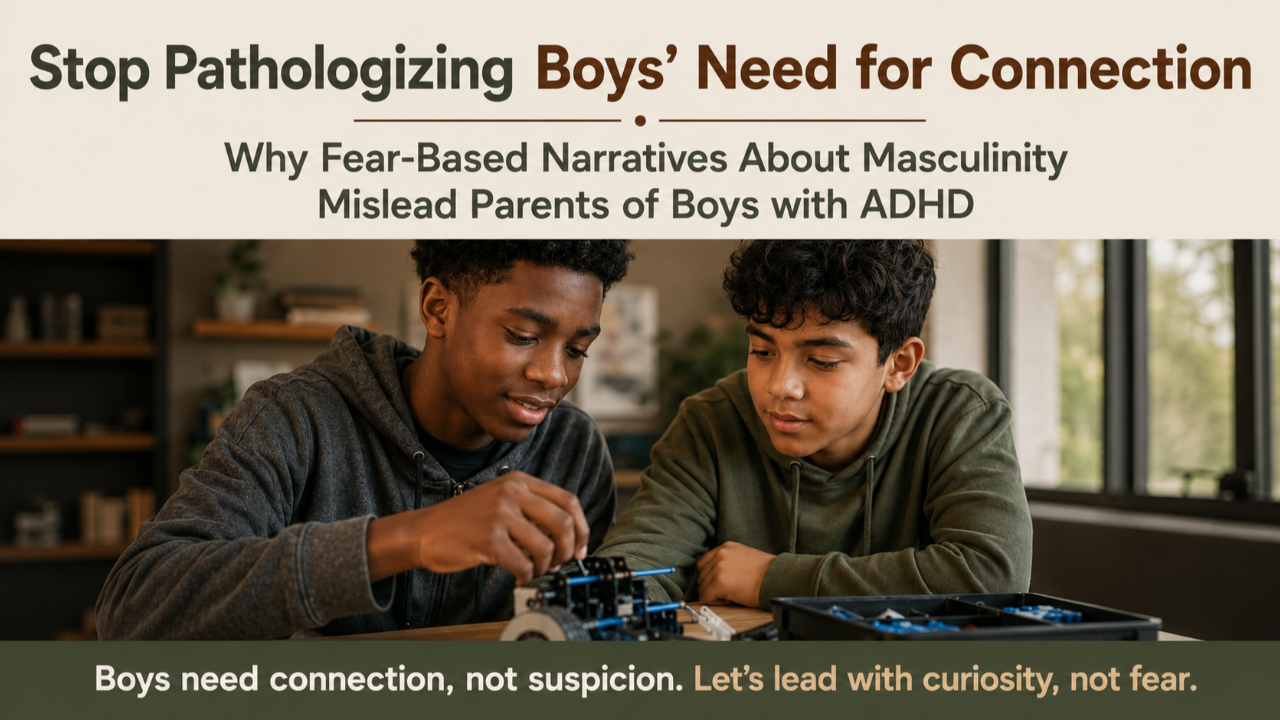
Boys often build connection through shared activities and interests, such as sports, gaming, exercise, projects, or conversations about subjects they both care about. The activity often provides the structure that helps the relationship grow.
This is poorly understood in the mental health field and in professions that serve individuals with ADHD and autism.
A boy's friendships may look different than the friendships between girls his age, or adult women. He may feel close to another boy because they share a sense of humor, play the same sport, enjoy the same game, or spend hours discussing a common interest.
Parents should not measure their sons' friendships against the ways adult women may seek connection. Boys need community, but it may not look familiar to the adults around them. That does not make it less meaningful or toxic.
Why This Matters for Boys With ADHD
This framing is especially concerning when applied to boys with ADHD.
Many boys with ADHD struggle to find a group where they feel accepted. They may have difficulty understanding the unspoken rules of friendship or recovering after a social mistake.
Shared interests can give relationships structure and make connection easier. Boys who feel isolated in real life may understandably look online for other boys and men who share their interests or experiences.
They may be searching for friendship, guidance, role models, or simply a place where they do not feel like the odd one out. That is a normal search for belonging.
For parents, the most useful question is not:
"What dangerous ideology is pulling my son in?"
It is:
"What is my son looking for that he is not finding elsewhere?"
That question leads with curiosity. It gives parents a better chance of understanding their son instead of reacting to him with fear.
The Research Does Not Prove the Article's Story
The ADDitude article cites a Common Sense Media report. It states that boys exposed to higher levels of masculinity-related content are more likely to experience low self-esteem and loneliness.
The report found an association between masculinity-related content, lower self-esteem, and loneliness. It did not prove that the content caused those outcomes.
It may be the other way around. A boy who already feels lonely, unsuccessful, or unsure of himself may be more likely to seek advice about confidence, fitness, friendships, dating, making money, or self-discipline.
It is also important to look at how broadly the report defines masculinity-related content. It places posts about building muscle, making money, fighting, dating and relationships, and weapons under one broad category.
The ADDitude article places these associations inside a larger story about boys being "funneled" into a toxic masculinity pipeline, but the research does not prove that causal story.
This distinction matters because the way adults explain a problem shapes the solution they offer.
When a lonely boy searches for guidance, parents can begin by asking what he needs. Is he looking for friendship, confidence, dating advice, or guidance from a male who seems to understand his experience?
Those needs are not evidence of toxicity.
The Problem With "Toxic Masculinity"
The article's language also deserves scrutiny.
Consider how this would sound if an article about girls warned parents about "toxic femininity." Most people would recognize that phrase as offensive and ask why the writer was attaching the word "toxic" to a female identity instead of naming the concerning behavior.
The same standard should apply to boys. Parents can address disrespectful or degrading behavior without treating masculinity itself as the problem.
The term "toxic masculinity" is often presented as though it has a clear and limited meaning. In practice, it can be applied so broadly that strength, competition, emotional restraint, male friendship, self-reliance, physical fitness, and the desire for status all become suspect.
That is why I view it as a gender-based slur.
If similar language would be considered demeaning when applied to girls and women, we should not normalize it when speaking about boys and men.
Richard Reeves has argued for moving away from deficit-based descriptions of boys and men and approaching their struggles with empathy rather than blame and shame.
The goal is to name harmful behavior accurately without attaching shame to being male.
What Are Boys Actually Looking For?
Boys need friendship, purpose, opportunities to become competent and useful, and relationships with other boys and men.
A fear-based warning about the "manosphere" does not meet those needs.
The Lens Parents Are Being Given
ADDitude's readership includes many adult women with ADHD, including mothers raising sons with ADHD.
The problem is the lens this article gives them.
Normal male interests become risk factors.
Male-oriented spaces become dangerous black holes.
Boys are treated as though they lack judgment.
Their search for connection with boys and men is reframed as vulnerability to radicalization.
Parents deserve better guidance.
They need help understanding that their son's need for male connection may not look familiar to them. It may be built around gaming, sports, humor, fitness, competition, or a shared interest that seems unimportant to an adult.
That does not make the connection less meaningful, unhealthy, or toxic.
Boys Need Connection, Not Suspicion
All boys need connection and community.
For boys with ADHD, finding that connection may be especially difficult. A boy who does not feel successful with peers in real life may look online for other boys and men who share his interests and understand his experiences.
That does not mean he is being pulled into something toxic. It may mean he is trying to meet a healthy need in the only place where he has found it available.
This article provides very little practical guidance about ADHD. It does not help parents understand why boys may be lonely, what they are looking for online, or how many boys form relationships.
Instead, it offers cultural commentary shaped by an implicit anti-male bias. Although it cites research, that research does not prove its broader story about a toxic masculinity pipeline.
Parents do not need another reason to fear what their sons might become.
They need help understanding what their sons are looking for and how to guide them toward belonging, confidence, purpose, and healthy community.
When parents lead with curiosity rather than suspicion, they are better able to help their sons find the relationships and communities they need.
Boys should not have to be portrayed as threats before their needs are taken seriously.
More Resources for Parents
I have videos on the ADHD Dude YouTube channel for parents who want to understand better how boys with ADHD build friendships, connect with peers, and develop the skills needed to sustain those friendships.
Watch videos on the ADHD Dude YouTube channel
FAQs