ADHD Child Destructive Behavior: When Your Child Breaks Things In Your Home (And How To Stop It)
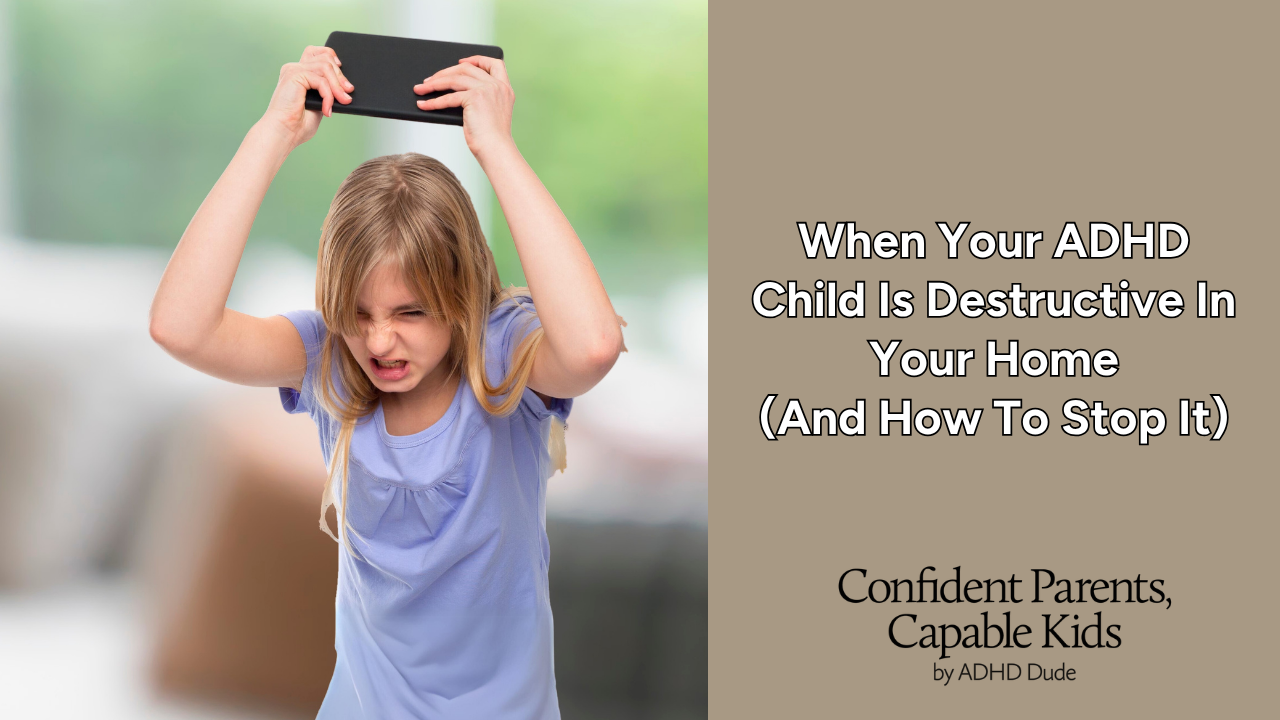
If your child with ADHD breaks things, throws things, or damages your home when they don't get their way, it can feel like you're walking on eggshells in your own home. Destructive behavior in children with ADHD is not impulsive. It is a way of asserting control when a child is not getting what they want. It continues when it is fed with talking, emotional reactions, and your undivided attention. It improves when parents stop feeding into it and follow a step-by-step plan.
Your child's behavior is not a reflection of your parenting. It is a reflection of not having had the right information and strategies until now. ADHD Dude teaches parents a step-by-step plan for destructive behavior, and it starts with understanding why it happens.
If you are ever concerned for anyone's safety in your family, call the police or take your child to the nearest emergency room to be evaluated.
Why Does My ADHD Child Break Things When They Don't Get Their Way?
Destructive behavior is often based in lagging and inconsistent use of cognitive flexibility, a core executive function skill. When a child with ADHD gets stuck and can't move on from not getting their way, they break things as a way to gain control.
This is why destructive behavior is not impulsive. It is a way of asserting control when a child is not getting what they want. It often shows up alongside other severe tyrannical behaviors, such as hitting parents or hitting siblings.
What Happens If Destructive Behavior Keeps Going?
The more destructive behavior happens, the more normalized it becomes to your child. Every time breaking things gets a reaction, your child learns it is an effective way to control what happens at home.
Why Does Talking or Empathizing Make Destructive Behavior Worse?
Meeting destructive behavior with empathy and emotional validation feels compassionate, but it often escalates the behavior. These responses feed into destructive behavior:
- Talking too much. Talking creates dysregulation.
- Over-validating.
- Over-empathizing.
- Giving the behavior your undivided attention and emotional reactivity.
Children with ADHD need roles clearly defined. They need to feel that their parents are in charge, and this creates emotional safety.
Many parents are also told to try therapy for their child. Talk therapy, play therapy, and occupational therapy have not been shown to improve behavior in children with ADHD, including destructive behavior.
How Do I Stop My ADHD Child's Destructive Behavior?
This is the step-by-step plan taught in ADHD Dude Parent Behavior Training.
Step 1: Enlist supporters
Ask people your child respects, such as a grandparent, an aunt, or a coach, to reach out after a destructive incident. They let your child know they are aware of the behavior and offer support. Supporters do not need to be local. Supporters are never used as a threat. The behavior is no longer a family secret, and secrecy is what lets it continue.
Step 2: Write an announcement
Write a letter to your child in which you lovingly take responsibility for allowing the destructive behavior to continue, and explain what you will change in response to their behavior. Read it aloud when your child is calm, with no distractions and no siblings present. You are not asking your child to change. You are telling them how you are changing.
Step 3: When destructive behavior happens
- Take a firm stance. Let your child know, calmly but firmly, that you do not accept the destructive behavior.
- Move, if possible, so your child doesn't have access to you or other family members.
- Do not try to calm them by talking.
- Do not restrain them.
Use Affective Calmness, which means showing calm when you don't feel calm inside. When the behavior no longer has an audience, it subsides. This sounds counterintuitive to many parents, who worry it's dangerous or that their child will become even more destructive. But when you stop giving the behavior an audience or emotional reactivity, it will subside.
Step 4: After your child is calm, supporters reach out
Ask your child's supporters to reach out so they can acknowledge the destructive incident and offer their support. Your child doesn't need to respond to the supporter. They need to hear them.
Step 5: Reconnection and "clean-ups"
Let your child know they are expected to make a small gesture, like helping with a chore or helping to repair what they broke, to make amends for their behavior. Clean-ups teach reciprocity in relationships. Your offer to help them is a gesture toward reconnection.
Step 6: Put daily expectations in place tied to "currency"
"Currency" is the privileges your child earns throughout the day for meeting expectations. When privileges are earned rather than given, your child learns accountability for their choices. Setting up daily expectations tied to "currency" is covered step by step in the Creating Daily Expectations course.
What Changes When You Have a Plan in Place?
With a plan in place, the back-and-forth arguing stops, expectations are clear, and your child learns accountability for their choices. Your child's behavior improves when you change how you respond to their behavior.
How ADHD Dude Helps
Talk therapy, play therapy, and occupational therapy have not been shown to improve behavior in children with ADHD, including emotional dysregulation and destructive behavior. That is why they are not part of the American Academy of Pediatrics' treatment recommendations. What the research shows is effective, and what the American Academy of Pediatrics recommends, is Parent Behavior Training. That is why ADHD Dude provides it.
I'm Ryan Wexelblatt, the creator of ADHD Dude. I'm the father of a son who was destructive when he was younger because he wasn't getting his way, a licensed clinical social worker (LCSW), and a former school social worker at schools for students with behavior challenges. ADHD Dude's evidence-informed Parent Behavior Training has been used by over 20,000 families in more than 50 countries.
The ADHD Dude Membership gives you every step of this plan, and the tools to carry it out:
- The foundation Parent Behavior Training sequence: Capable & Confident (ages 4-7) or Scaffolding Better Behavior (ages 8 and up), followed by Creating Daily Expectations (based on age).
- Capable & Confident includes a full module, A Daily Plan for Handling Physical Aggression, Breaking Things & Scary Outbursts.
- Scaffolding Better Behavior includes a full module, How To Handle More Severe Behaviors.
- Creating Daily Expectations shows you how to set daily expectations and tie them to "currency."
- Sample announcement letters and the supporter information sheet are in the downloads section, so you don't have to write them from scratch.
- Twice-monthly Live Office Hours to get your questions answered as you put the plan in place.
If your child's destructive behavior is controlling your home, start with the free webinar How to Handle Severe Behaviors. In this free webinar, you're taught how to deal with destructive behavior and other severe behaviors step by step: what to put in place first, exactly what to do in the moment, how to bring in supporters, and what to expect once you start. Watch the free webinar.
FAQs
Q: Is destructive behavior in ADHD kids impulsive?
A: No. It is a way of asserting control when a child is not getting what they want. It often starts when a child gets stuck and can't move on from not getting their way.
Q: Should I stop my child from breaking things in the moment?
A: Do not try to calm them by talking, and do not restrain them. Take a firm stance, move if possible so your child doesn't have access to you or other family members, and use Affective Calmness. If you are ever concerned for anyone's safety, call the police or take your child to the nearest emergency room.
Q: Why does talking or empathizing make destructive behavior worse?
A: Talking creates dysregulation, and giving the behavior your undivided attention and emotional reactivity teaches your child it is an effective way to gain control.
Q: Will therapy help my ADHD child's behavior?
A: Talk therapy, play therapy, and occupational therapy have not been shown to improve behavior in children with ADHD. What the American Academy of Pediatrics recommends is Parent Behavior Training.
Q: What is "currency"?
A: "Currency" is the privileges your child earns throughout the day for meeting expectations.
Q: Who can be a supporter?
A: Anyone your child respects, such as a grandparent, an aunt, or a coach. Supporters do not need to be local.
Destructive behavior doesn't improve through talking, lectures, or bigger consequences. It improves when you change how you respond, using an approach built for how ADHD brains learn. The ADHD Dude Membership gives you that approach: step-by-step Parent Behavior Training for the behaviors that wear you down.